(For the enthusiasts, turn on the following concert video, especially from 37.30 to 42.00)
Did it happen to you before that someone recommended an album, a book, or an artist, but for some reason you didn't care much about it; however, a month, year, decade after somehow you discovered that it's a true masterpiece? Well, The Unbearable Lightness of Being from Franco-Czech novelist Milan Kundera was a birthday present I got a year ago. After 30 pages I dropped it, I didn't find it interesting. Maybe it was my internship at the tabloid Blikk, or the book about Al-Jazeera that I had to read for my thesis made me so indifferent, but whatever the reason was, I put in a box, and it remained untouched for a year.
It stayed there until last week when I visited my mom and brothers who finally returned from England for a few weeks. Our house in Szentendre will be occupied by some friends so I had to pack my stuff and empty my old room completely. Roaming through the mess, I stumbled upon (yes I love that expression) the book. Being embarassed that I didn't read anything for a month, and still being regretful that I threw my birthday present so deep down, I picked it out, and started reading it.
It sucked me in. Irresistibly.
What made it perfect from the first second is the main motif, the continous presence and duel of fate and coincidence. Tereza, who had to be sent down on the river in a balrush basket just as it happened with Moses makes it pretty sure we are all destinned in our lives. Soon enough Kundera starts debating when he states Tomas needed six coincidences to meet Tereza, who was meant to be his. As the plot goes on, we see the characters suffering and/ or depending on chance and fate as well, until the very last moment when the following conversation takes place between Tomas and Tereza:
'Haven't you noticed I've been happy here, Tereza? ' Tomas said.
'Surgery was your mission.' she said.
'Missions are stupid, Tereza. I have no mission. No one has. And it's a terrific relief to realize you're free, free of all missions.'
Amongst all the truth he wrote, probably the one above is the quote that withstands time and keep its meaning to the coming generations. How unbearably hard to realize that we are not ought to do anything! That we are not obliged to find a mission. We do whatever we want to do in our lives, and finding a profession or mission should be just a part of it; see the great example of Pyotr I. Tchaikovsky, Russian composer who was educated to become a civil servant, and settled down with music only around his forties (note that learning music in Russia in his life was almost impossible).
The idea of complete aimlessness is troubling indeed. We are obliged to study, to work something for a lifetime; nobody asks us to fight for something until the end of our lives. Who should demand it anyways? If I become a teacher, and die as one, would it be my mission? Hardly. I chose it as a possible way out of thousands of other choices; I devoted myself to educate, to raise the youngsters, to make sure their head is filled with valuable knowledge. Would it be a mission? Never. No one appointed me to do it, to achieve anything in it; I felt like doing it fits my personality, my demands about my own life.
Let me bring another example, which I was thinking while reading already. Jonas, whom I became good friends during his stay in Eger, is learning to be a professional guitar player. Truth be told he is already one, on the way to become one of the greatests (that's the opinion of a laic though). Once he told me 'But you know it kinda sucks I have to do this. I have no other choice because I devoted myself to it. Sometimes I wonder what would happen if I could start it over; I'd choose football or anything (cooking I suppose). But I can't, no way I can quit now.' The mission he chose himself is envied by many (including myself). So how big the shock was when I heard him saying he is wondering what'd he do if he could start it over! I never dreamt anything but to find my mission; this guy has it, and imagines what if he could restart. And right after it, Kundera says there is no mission to find.
Lingering on these troubling thoughts, my dad came home yesterday from his walk and invited me for a glass of wine. Stargazing, I brought up the book and the idea of missions. He doesn't particularly likes Kundera ('The Joke is great and his writings are entertaining, but after some time it smells like a forced intellectual dissertation. He doesn't have topic, he just pushes his wisdom and sentences through until they team up to a shallow motif') but my topic definetely made him talk a lot.
We were talking about what did we regret in our past. I couldn't line up many things, and if I found anything, I said 'if I'm not making the wrong choice, this and that wouldn't have happened. So eventually the bad decisions turned out to be good'. But he snubbed me saying: 'That is bullshit. The wrong choice you made left you in a stupid situation, and even if you came out into a good one, you had a bad experience. You are making a mistake by thinking about the only varying one line of fate. But what if you make the good choice in time? You'd find happiness sooner probably.'
How true it is! When we make a bad decision, we try to sooth ourselves that eventually (after a month, or a year) we will come out of it with a positive balance. Stupid and coward we are, ignoring the possibility of making the right decision instead of mistaking, we just try to save ourselves.
As we see now, finding our mission is never obligatory, but making the good decisions is supreme to everything else. As we never know what happens with the "what if"-s (as Tereza would never know what would have happened if they stay in Zürich instead of moving back to the communist occupied Prague), the best (and only) thing we can do is to make the right decision. To apply for a job or to university, to quit it and start writing our own book, to start travelling, to learn to play the guitar, to learn a new language, to love, to cheat, to hate, to marry, to divorce, to give birth, to be a kitch, or to shit on the street; anything and everything is in our power. But under the weight of the lightness of our lives we just tremble, complain, suffer, crawl ahead, not admitting that standing up and walking with pride is ridiculously easy.
We will never know which of the four characters (I missed out talking about Sabina and Franz though) stood up eventually. When Franz dies, Kundera gives the slap in the face: when we already start to believe in the unbearable lightness of being, we got a punch by the unbelievable fragility of life.
Despite all the dark and grim events, book never lifted me so high, opened my eyes, blew through the swamp of my brain like a hurricane. Anyone who wants his grey matter working should read it, and at the end may find out why Karenin is the truest of all characters.

2012. augusztus 3., péntek

2012. augusztus 2., csütörtök
Three songs for the summer
The contrabasser strikes back
I recently had the chance to get to know Zaz, this once street jazz singer, nowadays popular artist touring the world. Once my enthusiasm was over, I realized how much the double bass player and guitarists are shaking up her performance (also it'd be unfair to call it her performance). Youtube was kind enough to guide me to a comment which was made by the double bass player (coincidence, huh Monika?). Fast enough I ended up at his myspace, and although couldn't find much, I was really proud to find something new that makes me listen to it over and over. Mathieu Verlot, ladies and gentlemen: click on the link and browse through his tracks, my fav is Bossa Dorado, which would surely fit a hot summer night.
Be cool
Each summer needs a song that immortalizes the image of beaches, girls, cocktails and relaxation (and all combined). The topic is weary enough, but let us admit we all need a chillin' song for the hangovers, for sitting by the pool, or just trying to survive during the dog days. I present you Poolside, which caught my attention thanks to my second couchsurfer, Matthieu (thanks again for it). It doesn't take to be a genius to realize they play exactly the genre described above: simple, groovy, simple, chilling, and simplicity again. Slow down, says the title and we obey: put it on repeat and beggin' the chillin'!
I recently had the chance to get to know Zaz, this once street jazz singer, nowadays popular artist touring the world. Once my enthusiasm was over, I realized how much the double bass player and guitarists are shaking up her performance (also it'd be unfair to call it her performance). Youtube was kind enough to guide me to a comment which was made by the double bass player (coincidence, huh Monika?). Fast enough I ended up at his myspace, and although couldn't find much, I was really proud to find something new that makes me listen to it over and over. Mathieu Verlot, ladies and gentlemen: click on the link and browse through his tracks, my fav is Bossa Dorado, which would surely fit a hot summer night.
Be cool
Each summer needs a song that immortalizes the image of beaches, girls, cocktails and relaxation (and all combined). The topic is weary enough, but let us admit we all need a chillin' song for the hangovers, for sitting by the pool, or just trying to survive during the dog days. I present you Poolside, which caught my attention thanks to my second couchsurfer, Matthieu (thanks again for it). It doesn't take to be a genius to realize they play exactly the genre described above: simple, groovy, simple, chilling, and simplicity again. Slow down, says the title and we obey: put it on repeat and beggin' the chillin'!
That bass!
Time after time I'm getting weakened and let r'n'b and rap flow into my days and weeks. Normally it only occurs while working out: nothing is better for one more push up then some beats brought by Dr. Dre. But sometimes it just happens that I hear a bass beat and I can't get it out of my head. The same happened with No Church in the Wild by Kanye West. I didn't want to like it, but it slipped through the barriers of my snobbery, and hit the bullseye. "Fat black beat" as we call it with friends; hope you like it.
Originally I wanted to write about the brand new Frusciante album, but I truly and desperately feel it's a disgrace. Maybe some other fans will educate me about it; looking forward to it. Until then, be good to each other, watch the Olympics, and read the blog! New posts are on the horizon, including a little phylosophical one on Kundera's Unbearable Lightness of Being which I lately finished reading. So prepare and enjoy the rest of the summer!
2012. július 26., csütörtök
Just a regular summer dusk
Many of you may wonder what makes shitty weather at Lake Balaton bearable. A little teaser of what is going on in our house during these days... (yeeees, bad sound quality)
Dad is practising for a little concert of his, and during his sessions windows are open so his music just flows across the surroundings. Pretty awesome.
2012. június 14., csütörtök
Few words about the german national football team
I never really liked the german football team. I don't know where are the origins of this feeling; maybe I was harrassed too many times during my childhood by some badass german kids next to Lake Balaton. Or maybe because long time ago when I was a die hard Real Madrid fan, I hated everytime Bayern Münich beated them.Still the biggest possibility is that I just don't like the way they play.
But I know one thing for sure: it's not because they are full of immigrants. The popular theory which says Germany wouldn't be so great without it's foreigner-origined players is a utterly bullshit. All who like football a bit, should quote Gary Lineker, former forward of Germany's archenemy, England:
France. It has been like this forever, but the '98 World Champion team had just a few "true" frenchmen amongst their ranks, many of them sitting on the bench. Without googleing: E.Petit, F.Barthez, D.Deschamps, L. Blanc, oops wanted to put Yuri Djorkaeff but he really doesn't fit, does he? Ever since, at least half of their team consists black african origined players, and let's say one quarter north-african (Tunisia, Morocco etc.).
England. The cultural melting pot of Europe. You just have to walk the streets of London, and you'd be completely lost- almost every second man speaks another language than English. Lately, the national football team boosted a great number of black african players, including the since-retired E. Heskey, one of the most expensive defenders in English club football, R. Ferdinand, or the young talent, T.Walcott.
Netherlands. Nobody says a word about them although more than half of them are black, and the new-age Dutch team relied on great players such as C.Seedorf, E.Davids, or all-time Dutch national team top scorer P. Kluivert.
(Spain should be a whole separate chapter, since they don't have many other ethnicity, but the catalonian-basque issues are a unique problem in their national team.)
Portugal. Some of the biggest dribblers of the national team are black: such as Nani, or base pillar of defense Miguel, not to mention Liedson..
I could bring up a lot of other national teams with players coming from other ethnicities or nations (Ibrahimovic from Sweden, Balotelli from Italy etc.), but that'd take too much time, so let's come to a stop at our main topic:
Germany. Probably the list of foreign-origin players would be as long as England's or France's. So why are still people taking it so serious? Because of their past? Their history? Because they shouldn't field any other players than pure-blooded Germans? These old-fashioned thoughts are so shameful, especially in Europe, especially with some basic knowledge of what happened before. And still there are plenty of those who really feel it's unfair that Germany has foreigners in their national team.
What everybody forgets is that maybe Germany makes those steps for 60 years from now on to make people forget their past. And for that, they deserve no racist judging, hate speech, but respect in all possible ways.
But I know one thing for sure: it's not because they are full of immigrants. The popular theory which says Germany wouldn't be so great without it's foreigner-origined players is a utterly bullshit. All who like football a bit, should quote Gary Lineker, former forward of Germany's archenemy, England:
"Football is a game for 22 people that run around, play the ball, and one referee who makes a slew of mistakes, and in the end Germany always wins."I won't list all the euro and world ch'ships they have won, the great players they had etc. I more like to emphasize how stupid is to judge a team because of the mixed ethnicity they have.
France. It has been like this forever, but the '98 World Champion team had just a few "true" frenchmen amongst their ranks, many of them sitting on the bench. Without googleing: E.Petit, F.Barthez, D.Deschamps, L. Blanc, oops wanted to put Yuri Djorkaeff but he really doesn't fit, does he? Ever since, at least half of their team consists black african origined players, and let's say one quarter north-african (Tunisia, Morocco etc.).
England. The cultural melting pot of Europe. You just have to walk the streets of London, and you'd be completely lost- almost every second man speaks another language than English. Lately, the national football team boosted a great number of black african players, including the since-retired E. Heskey, one of the most expensive defenders in English club football, R. Ferdinand, or the young talent, T.Walcott.
Netherlands. Nobody says a word about them although more than half of them are black, and the new-age Dutch team relied on great players such as C.Seedorf, E.Davids, or all-time Dutch national team top scorer P. Kluivert.
(Spain should be a whole separate chapter, since they don't have many other ethnicity, but the catalonian-basque issues are a unique problem in their national team.)
Portugal. Some of the biggest dribblers of the national team are black: such as Nani, or base pillar of defense Miguel, not to mention Liedson..
I could bring up a lot of other national teams with players coming from other ethnicities or nations (Ibrahimovic from Sweden, Balotelli from Italy etc.), but that'd take too much time, so let's come to a stop at our main topic:
Germany. Probably the list of foreign-origin players would be as long as England's or France's. So why are still people taking it so serious? Because of their past? Their history? Because they shouldn't field any other players than pure-blooded Germans? These old-fashioned thoughts are so shameful, especially in Europe, especially with some basic knowledge of what happened before. And still there are plenty of those who really feel it's unfair that Germany has foreigners in their national team.
What everybody forgets is that maybe Germany makes those steps for 60 years from now on to make people forget their past. And for that, they deserve no racist judging, hate speech, but respect in all possible ways.
2012. június 10., vasárnap
Coincidence
Yes I know I didnt update the blog for a long time, but I have my reasons (finals, if you ever heard about it). Today's post I wont make a big effort either. Just a short (10 mins) vid on coincidence, accidental happenings. Its a great little addition for the tattoo (die symbol) I have. I always tried to explain what do I think about accidentals, but this guy definetely brings more point, not to mention he is a native speaker so it's much easier to understand him. Destiny-believers, fate supporters, behold, because this video is gonna shock your world at the very foundation! :)
2012. május 14., hétfő
Little Laurens!
the final compulsory stuff during my media studies. special thanks to nalan for an above-school-quality camera.
2012. május 5., szombat
Hot trip to heaven
The title refers to this


Egle has to catch a train back to Eger, so we rub a few teardrops in the station, and plan our next move. This is how we do it, desperately waiting 4 hours to for our train to Arad (bank of river Kőrös):

Getting to Arad makes no difference when purchasing a map makes us realize there is no way we get to the Serbian border from there. So Timisoara (Temesvár) is our next stop. Hopes are low and concerns are high as we recognize: no train nor bus to the border, not even the day after. Making peace with the idea of hitchiking to the frontier on Thursday, renting a motel room is the last action of the day. My apologies, the last one is the moment of joy when (after a well-deserved and needed shower) we eat our dinner:
 Our luck reaches another level when the fifth car stops and takes us to the border next morning. Things looks suspicious: no cars, no people there, but being convinced we are at the right place, we head towards the crossing. And here I make my biggest (and so far, only) violation against law:
 In case you wonder, FYI: the picture immortalizes the moment when I already passed the Romanian, and about the cross the Serbian border. Illegaly. No surprises when on the Serbian side a sentry guard runs and shouts, and then takes us to the building, saying problema.
Our map lied, big time. The frontier is closed. After three hours of waiting in a room (from which we can't get out), they happily announce: we can go to Serbia. Hooray! Wait a second... Romanian patrol car rolls in, and takes us to their office. They make us write a declaration about why we violated the closed border, how we came here etc., telegram style but short novel length. After an hour of desperation, being questioned by officers, whose English is below-basic (and that's a compassionate assesment), the miracle happens: they let us go.
We don't even recognize walking three kms in the plains (that's a lie though), and crossing the border to Serbia is the biggest relief since Pál Schmitt's resignation.
Srspka Crnja is the first town we cross, without googleing or a native speaker this name is a definite tongue twister. Who cares, if an albanese moslim confectioner who speaks Hungarian takes you to Kikinda? No one, right? So our happiness is unmatched when we get on the bus that heads to Horgos, the closest Serbian town to the Hungarian border:
 From here a taxi takes us to Szeged: we are finally at home. No bus nor train again, but it doesnt'bother any of us- we are in Hungary. Motel, and taking a bus in the dawn- we finally arrive to Eger 11 am., Friday.
The pleasant trip, designed for three days got and additional two; but the memories and adventure we got counts much more than any kind of difficulty we faced.
Next year, same time, same place?
Months after stepping out of Hungary, I eventually decided to leave the country for three days. The original plan was to hitchike until Oradea (or Nagyvárad in hungarian), Romania, spend a day there and catch a train back to Eger on Wednesday. As some of you may know, one of my fav quote is as follows:
The good traveller has no plans nor intention on arriving
Well, this time I had no intention not to arrive as it was planned. Guess what, nothing went according to my ideas.
The whole thing started a bit slow, getting rides in the hungarian plain Alföld (more precisely-Hortobágy) takes time. Not to mention the burning mid-July sun... with a stupid color invertion, here is how we looked like during these hours (Nalan-Egle-Me):

After 6 hours we reached Debrecen, east to Eger (normally it should be around 1,5 hrs on highway) on road 33 (secondary). Not much time left until sunset, so catching a ride towards the border and also a bus brought us just 10 kms short on reaching Romania. Monday's last car finally took us to Oradea, just before 20.00 (ROM time).
In order to keep attention, important sidenote: what do you get if you mix a turkish passport, an EU visa plus entering Romania, a non-Schengen country? Answer: going back to Hungary is only possible by visiting another country.
Couchsurfing is still awesome, our host is a cute, young couple. The flat makes us feel like we were at home, and their little baby boy, Peter is the icing on the cake:


Oradea is a busy, green town in Western Romania. People speak both Romanian and Hungarian, so the being abroad feeling is not complete for me. Not that it takes anything away from the values of the town, we have a great day strolling through the streets.


The schorching sun makes us run for shelter, Laktobar is definetely the place to hide in with its retro feeling and extravagant decoration:


After refreshments, the castle is our final destination. The little pond there makes the girls fully satisfied with the sightseeing:

Our day is complete with a few drinks in Moscow, an alternative bar situated in the centre; we all prepare for going back the next day. But Wednesday morning wakes us up with a shocking information (remember my sidenote): Nalan can't go back to Hungary directly. After a few calls to turkish embassies, the previous sentence is more than confirmed, we are obliged to visit another country before re-entering Hungary.
Egle has to catch a train back to Eger, so we rub a few teardrops in the station, and plan our next move. This is how we do it, desperately waiting 4 hours to for our train to Arad (bank of river Kőrös):
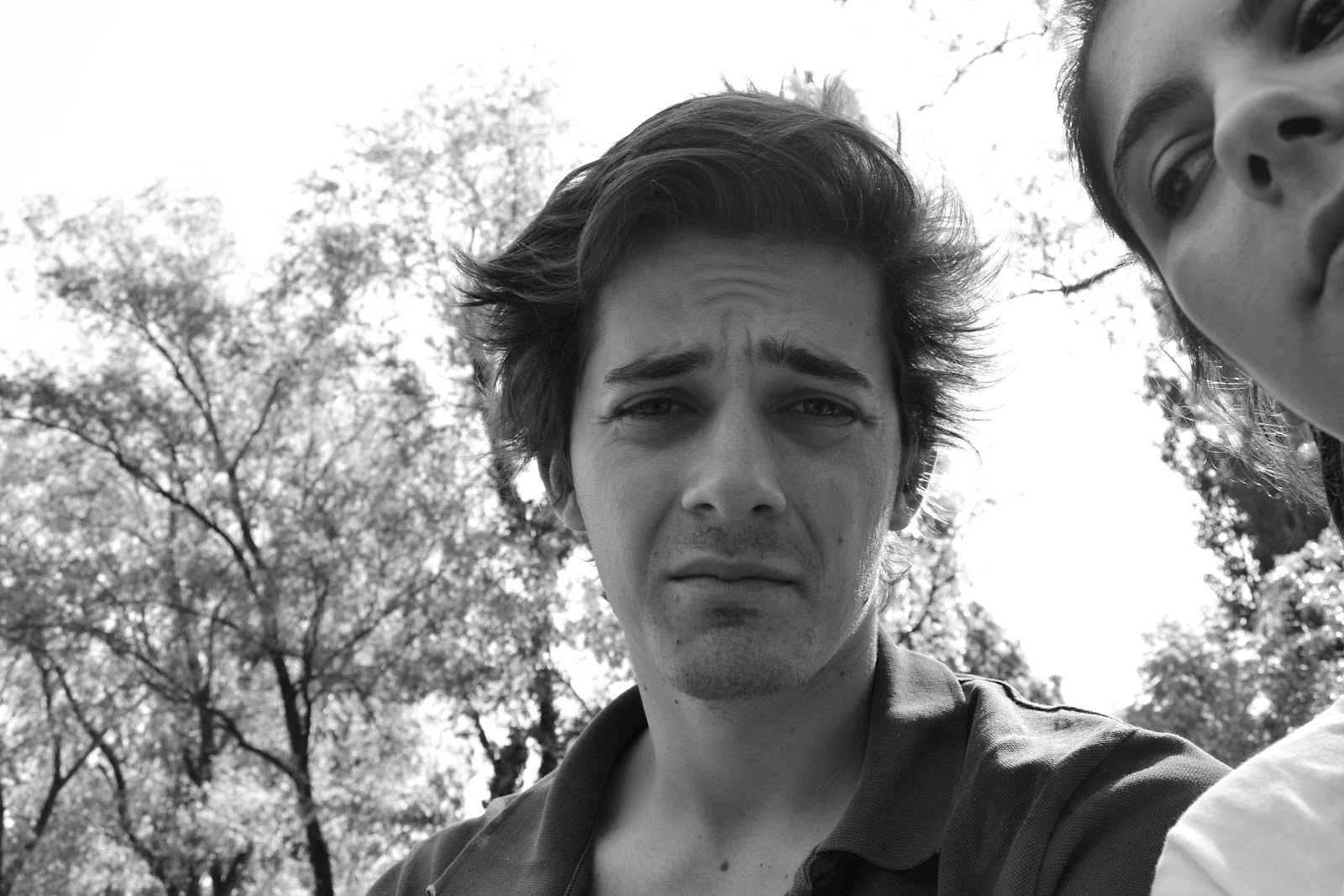
Getting to Arad makes no difference when purchasing a map makes us realize there is no way we get to the Serbian border from there. So Timisoara (Temesvár) is our next stop. Hopes are low and concerns are high as we recognize: no train nor bus to the border, not even the day after. Making peace with the idea of hitchiking to the frontier on Thursday, renting a motel room is the last action of the day. My apologies, the last one is the moment of joy when (after a well-deserved and needed shower) we eat our dinner:


Our map lied, big time. The frontier is closed. After three hours of waiting in a room (from which we can't get out), they happily announce: we can go to Serbia. Hooray! Wait a second... Romanian patrol car rolls in, and takes us to their office. They make us write a declaration about why we violated the closed border, how we came here etc., telegram style but short novel length. After an hour of desperation, being questioned by officers, whose English is below-basic (and that's a compassionate assesment), the miracle happens: they let us go.
We don't even recognize walking three kms in the plains (that's a lie though), and crossing the border to Serbia is the biggest relief since Pál Schmitt's resignation.
Srspka Crnja is the first town we cross, without googleing or a native speaker this name is a definite tongue twister. Who cares, if an albanese moslim confectioner who speaks Hungarian takes you to Kikinda? No one, right? So our happiness is unmatched when we get on the bus that heads to Horgos, the closest Serbian town to the Hungarian border:

The pleasant trip, designed for three days got and additional two; but the memories and adventure we got counts much more than any kind of difficulty we faced.
Next year, same time, same place?
Feliratkozás:
Bejegyzések (Atom)